
on being a solution
and trying not to do damage

I came across this post on my Twitter timeline a few days ago:
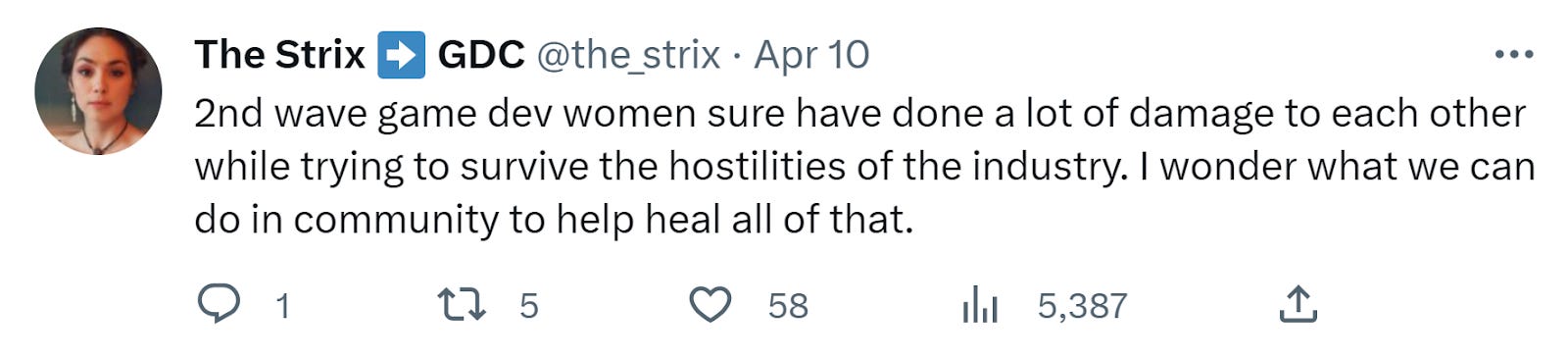
I’m unsure whether I belong to the second wave of game dev women, or even what denotes each wave. But in the most messed up way imaginable, I know I haven’t done much damage to women in games because I haven’t had the opportunity to do so (but if I have, please let me know). Not that I want to—a handful of my managers (shoutout to Jo, you rock) and mentors (shoutout to a lot of people, you all rock) have been women, but in my 2.5 years in games, I have never worked with another woman at my level of seniority.
Still, I get where that instinct comes from. My other, equally male-dominated passion in life trained me to foster hostility towards other women. I remember going to Science Bowl competitions in high school and becoming uncharacteristically aggressive toward teams that were mostly girls. I was a hater. I could rationalize how a boy would perform better than me—he probably never experienced a drought of encouragement, or a lack of access to STEM resources, or criticism or isolation or self-doubt. But being outperformed by a girl was a blow to my personhood, even when those same mechanics were at play (or even in my favor).
I think I was socialized to be lonely; I was taught that my novelty gave me access to certain discursive circles, and I was valued in those circles because I was the only one of my kind. I tokenized myself.
I’ve let a lot of those feelings go since then. Becoming a woman is traumatizing at best, and going through that process alone would have been doing a huge disservice to myself. Somewhere in between the self-help bestsellers and tech girl influencers, I did actually find some type of kinship. I might have even swung too hard in the opposite direction: I have some Puritanian conception of women in male-dominated professions—not along the axis of religion or any forms of constraint that come from religion specifically, but more like “you are obligated to fix all of the hurt that we experienced growing up, and you are fundamentally a bad person if you add to it or exploit it for yourself.”
Coming back to Strix’s question, there’s a big part of me that wants to say that it’s not my problem, that everyone else should solve it, and that it’s okay for me to demand that the professional world treats me like a person. And I both sincerely agree with that take and acknowledge that it is very much my problem and nothing will change if I don’t take it personally.
In a parasitic way, I derive my sense of belonging in this industry by conceptualizing myself as a solution: everything is a problem for me to solve. If a colleague is having relationship issues, I know he will expect me to manage his emotions, even though I am probably the least emotionally mature person he could have asked. If communication channels fail, I know leadership will expect me to restore them, even though I have my own challenges with communication. If a team lacks diversity, I know they will hire me, and that I will be invited to every fireside chat, or town hall meeting, or other flavor of polite attempt at masking the larger issue at hand. There’s something reassuring about knowing that despite all of the problems in this industry, there’s a perfect Noor-shaped identity for me to squeeze into. As long as there are problems, I get to exist.
I still have a lot of hostility left, but it’s less directed. Since I started working in games, I’ve become an angrier person. I began complaining regularly and talking a massive medium amount of shit. I openly view other people’s accomplishments as a threat to my own. I am deeply unhappy and recognize myself in my unhappiness. But I exchange those feelings to feel wanted, and I can’t say whether I want to be treated like myself or a person anymore.